AI CAPSULES
What if AI came in a capsule?
Encapsulate AI. Keep knowledge in human hands.
Imagine a self-contained AI system that brings useful AI capability and trusted knowledge libraries to the people and organisations that need them. A system that can work without the cloud, incorporate locally governed knowledge without sending it away, and leave people in control of how knowledge is used and shared.
This is the idea behind AI Capsules.
Bringing AI capability in without taking knowledge out
Most AI services ask people to connect to infrastructure somewhere else. Questions, documents and information may travel to external systems, while access depends on connectivity, service providers and conditions determined outside the organisation.
For many purposes, that arrangement works well. But reliable connectivity, technical support, computing resources and institutional capacity cannot always be assumed. And where knowledge is sensitive, culturally significant or governed by a community or institution, sending it to an external system may not be appropriate.
AI Capsules reverse the starting point. Instead of bringing people's knowledge into remote AI systems, they bring AI capability and trusted external knowledge into locally controlled environments.
The capability can move. Authority over local knowledge need not move with it.
What is an AI Capsule?
An AI Capsule is a self-contained, locally controlled AI system that combines trusted knowledge libraries, local AI capability and human-governed workflows.
It is designed to operate without continuous internet connectivity or dependence on external AI services. People can work with locally governed materials while retaining authority over which sources are used, how information is transformed and what may be communicated outside the system.
We encapsulate AI so that capability can move in without knowledge having to move out.
An AI Capsule is not simply an offline chatbot. It is a deployable knowledge environment, designed around the people, purposes and operating conditions it needs to serve.
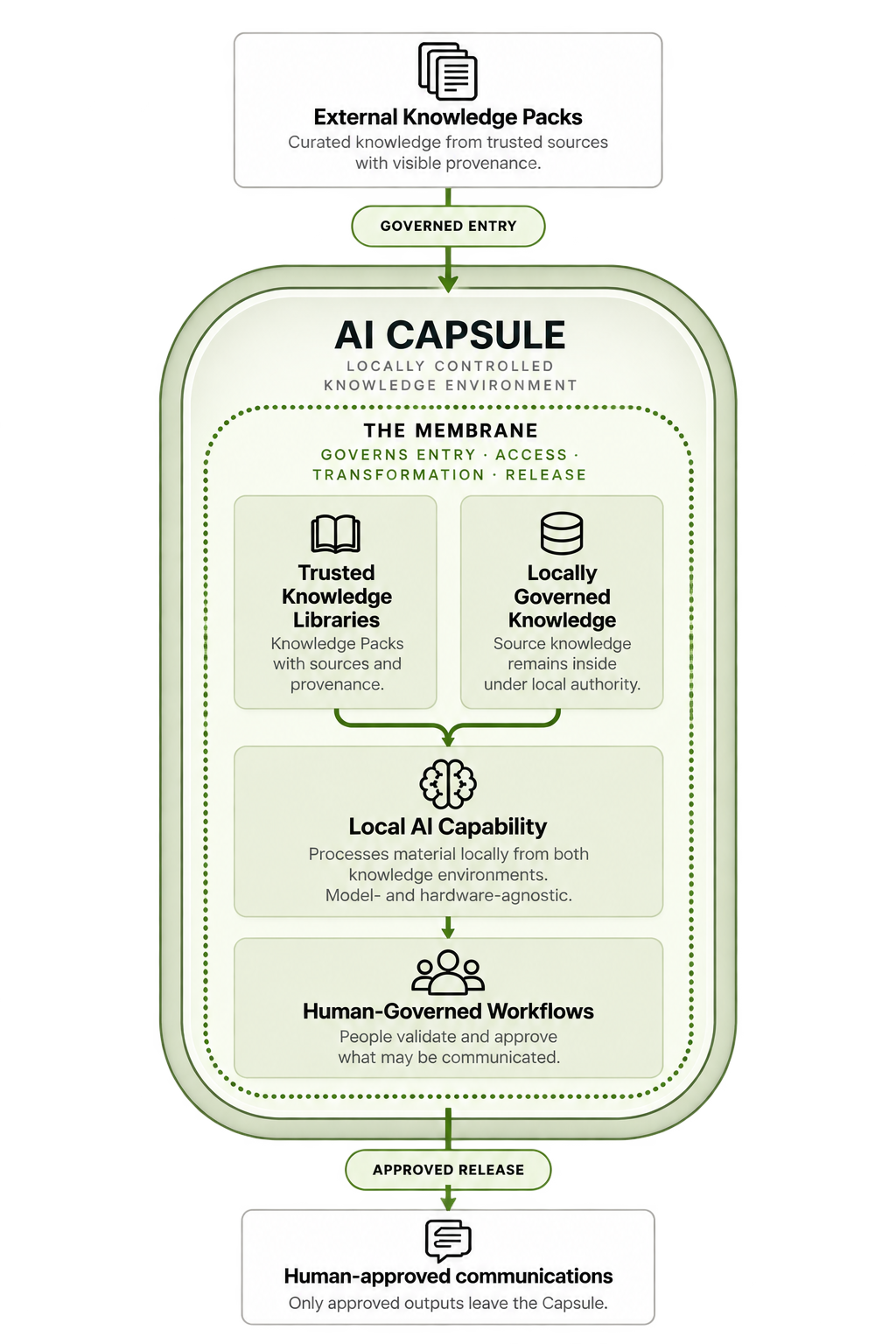
Four elements of an AI Capsule
01. Trusted Knowledge Libraries
A Capsule can contain curated collections of practical, scientific, educational or institutional knowledge. These might cover public health, climate adaptation, agriculture, biodiversity or other subjects relevant to its users.
Knowledge is organised into portable Knowledge Packs: collections accompanied by information about their sources, versions, attribution, licensing and intended use. Packs can be prepared and distributed externally, then brought into a Capsule through a download or offline transfer such as a USB drive.
A Knowledge Pack makes external information more accessible and traceable. It does not automatically make every claim correct, locally applicable or authorised for every use. Those questions still require judgment.
Our first reference implementation will begin with an Audiopedia Health Knowledge Pack. Over time, we hope to work with additional knowledge partners to make other trusted resources available in this form.
02. Locally Governed Knowledge
Organisations may need to work with their own documents, terminology, observations, communications or community-approved knowledge.
An AI Capsule can hold such materials locally, separately governed from the externally supplied Knowledge Libraries. In the first reference architecture, local source knowledge remains on the machine by default. It is not automatically synchronised with outside services, uploaded to a central repository or contributed to model training.
But local storage is only a technical condition. It does not establish who has the right to use or share knowledge. That authority must be defined by the people, communities or institutions with legitimate responsibility for it.
03. Local AI Capability
AI runs on hardware available to the organisation, using a model suited to the task. Depending on the configuration, it can help people find relevant material, compare sources, explain complex information, identify uncertainty, prepare validation questions and develop drafts for radio, audio, print or other communication formats.
The architecture is model-agnostic and hardware-agnostic. It is not tied to a single AI model, vendor, processor or device type. A Capsule might run on a laptop, a mini-PC or a local shared server, depending on requirements and available resources. Models and hardware should be replaceable as technology develops.
Agnostic does not mean every model will work on every device. Each implementation needs a tested configuration that fits its actual conditions: available power, computing capacity, languages, maintenance, cost and the work people need to accomplish.
The aim is not the largest possible model. It is the minimum sufficient intelligence within a viable system.
04. Human-Governed Workflows
An AI Capsule supports existing human processes rather than taking authority over them.
A communicator, healthcare worker, teacher or local organisation might select relevant sources, ask AI to compare them, review a draft, consult others, correct or reject claims, and decide whether the result should be shared.
We call this orientation AI-in-the-Loop.
Humans hold authority. AI participates.
AI can assist with knowledge work. It cannot decide by itself which knowledge is legitimate to use, whether a cultural interpretation is appropriate or whether a communication should be released.
The Membrane: governing the boundary
AI Capsules are our first proposed implementation of The Membrane, LowRes.AI's principle of governed permeability.
The Membrane asks what may enter a knowledge environment, what may happen inside it and what may leave. Crucially, its rules apply not only to source materials but also to what AI derives from them.
The first Capsule reference architecture follows a deliberately simple default:
Trusted external knowledge may come in. Local source knowledge stays local. Human-approved communication may go out.
Technical choices such as local inference, separated knowledge collections, visible source information and controlled export can help put these rules into practice. They cannot, by themselves, establish legitimate authority. Nor can they replace meaningful human review, especially where an output might reveal or misrepresent protected knowledge.
Encapsulated does not mean opaque.
The people operating a Capsule should be able to understand which knowledge resources it contains, which model it uses, where important claims originate and what happens when an output is shared.
From knowledge to useful communication
A Capsule should not stop at producing an answer on a screen.
Consider a community health organisation preparing accessible information about preventing diarrheal disease. It can draw on a trusted public-health Knowledge Pack and locally provided information about language, everyday circumstances and appropriate communication formats.
AI could help retrieve guidance, compare it with local context, identify uncertainties and prepare a draft. Human communicators and relevant experts would then review medical claims, assess the representation of local knowledge, adapt the language and approve any material for release.
The result might become a radio programme, a voice message, a community-meeting resource or an audio file distributed through basic mobile phones.
The purpose is not to automate local judgment. It is to give people better tools for turning knowledge into communication and action under their own authority.
AI Capsule for Community Communication
Community communication begins with people deciding what needs to be understood, discussed and shared. An AI Capsule could help communicators work with two distinct kinds of input: trusted external Knowledge Packs with visible sources and provenance, and locally held knowledge used only under the authority of its community or knowledge holders. The two need not be merged into a single dataset.
AI can support dialogue between these sources, make differences and uncertainties visible, and help develop drafts in locally useful formats. Human communicators and relevant knowledge holders review the interpretation, decide what may be communicated, and approve the final material. Community channels carry that material outward; questions and feedback then inform the next round of human-led work.
- 03 / DIALOGUEAI-supported dialogue and communication developmentCompare sources, surface uncertainty, and develop drafts without erasing their different authority.
- 04 / DECISIONHuman review and approvalPeople validate claims, context, language and what may leave the Capsule.
- 05 / DISTRIBUTIONCommunity channelsApproved communication can reach people through appropriate local formats and channels.
- 06 / FEEDBACKListen, learn, reviseResponses return to the next human-led dialogue and communication cycle.
First experiments
The published AI Capsule — Technical Preview documents a Qwen2.5-based, local, multilingual, source-grounded experiment using fictional materials. It is a technical learning step, not a validated community-communication system or AI Capsule 1.0.
A newer, separate Qwen3 dialogue experiment examines how communicators might compare external and locally governed knowledge while developing communication. It is exploratory and is not included in the public Qwen2.5 Technical Preview repository. Neither experiment establishes that the full human-governed workflow above has been demonstrated in community use.
One architecture, different environments
An AI Capsule is not a proprietary box or a fixed hardware product. It is a reusable architecture that can be configured for different tasks and operating conditions.
An Indigenous communication organisation might work with climate and biodiversity information alongside locally governed knowledge. A community radio station might combine verified resources with local reporting. A rural health organisation might prepare health education from trusted sources and locally approved protocols. A school might use selected educational material without reliable connectivity. An agricultural extension organisation might combine practical guidance with locally validated observations.
These examples are potential applications, not claims of deployments already operating.
The knowledge, workflows, model and physical configuration will vary. The underlying commitments to provenance, human authority, local viability and governed exchange should remain.
AI Capsule 1.0: the first reference implementation
We are developing AI Capsule 1.0 to test whether these principles can work together in one understandable, locally operated system.
The initial reference system is intended to combine a local AI model, an Audiopedia Health Knowledge Pack, a separate local-knowledge environment, source-grounded retrieval and drafting, and a human-controlled review and export process. It should work without external AI APIs.
One proposed integrated demonstration is the Diarrhea Song Test; it is not the only or first experiment in this programme.
This proposed test draws inspiration from an earlier Audiopedia project with Aka communities in the Congo, where a community-created song brought public-health messages into dialogue with locally held knowledge about medicinal plants.
We want to investigate whether a Capsule can support a comparable process of knowledge mediation: finding relevant external guidance, working with locally authorised material, keeping the sources distinguishable, avoiding unsupported medical or cultural claims and preparing a useful draft for human review.
This is not an attempt to have AI autonomously produce Indigenous cultural expressions or determine the efficacy of traditional treatments. It is a test of whether AI can assist careful, human-governed knowledge work without extracting its local sources.
AI Capsule 1.0 is under development. These are design objectives, not yet demonstrated capabilities or a product available for deployment. We intend to document the results, including failures and limitations.
Open architecture. Local ownership.
AI Capsules are being developed as reusable public-interest infrastructure using existing technologies rather than a proprietary foundation model or a closed appliance.
We aim to publish the reference architecture, implementation guidance and reusable components openly, subject to software licences, content rights and legitimate knowledge-governance restrictions. Public Knowledge Packs can be shared and updated without creating a central repository for locally governed source knowledge.
Viability also depends on what happens after installation: maintenance, training, language support, governance, replacement parts and the ability of local organisations to adapt the system. A technically independent machine can still create institutional dependency if these responsibilities are ignored.
That is why we intend to develop AI Capsules with knowledge partners and local organisations, and to let actual use reshape the architecture.
The Membrane defines the governing principle. AI Capsules are our first attempt to make it operational.
Read The Membrane: Knowledge, power and human agency in the age of AI →
AI Capsules are an emerging reference architecture developed within LowRes.AI, an initiative of Audiopedia Foundation. The first implementation is under development. Future design choices and claims of practical benefit will need to be tested through co-development and real use.